Creating a Reward-Based Training Routine That Fits Real Life
Training a dog can look wonderfully simple when demonstrated in a short video. The room is quiet, the dog is attentive and the reward appears at exactly the right moment. At home, however, the experience is often less polished. The doorbell rings, dinner is cooking, someone walks through the room and the dog suddenly becomes interested in everything except the lesson.
That does not mean training has failed. It simply means dogs learn within the noise and unpredictability of everyday life.
A useful training routine should therefore fit around normal household activities rather than requiring perfect conditions. When rewards, timing and expectations are handled consistently, even brief interactions can help a dog develop better manners and make calmer choices.
Start with behaviours that make daily life easier
It is tempting to begin with impressive tricks, but the most valuable behaviours are usually quite ordinary. Waiting before going through an open door, settling on a mat, responding to a name and walking calmly towards the car can make a noticeable difference to life with a dog.
Choose one clearly defined behaviour at a time. “Behave yourself” may make sense to a person, but it gives a dog very little practical information. “Keep four paws on the floor when greeting visitors” is far more specific.
Clear goals also help family members remain consistent. If one person rewards the dog for sitting while another encourages excited jumping, the animal receives conflicting information. The dog is not deliberately ignoring the rules; it is working out which behaviour is most likely to produce a rewarding response.
Before beginning, everyone in the household should agree on three things:
- The word or hand signal used for the behaviour
- What a successful response looks like
- How the dog will be rewarded
This simple agreement prevents a surprising amount of confusion.
Find out what your dog genuinely values
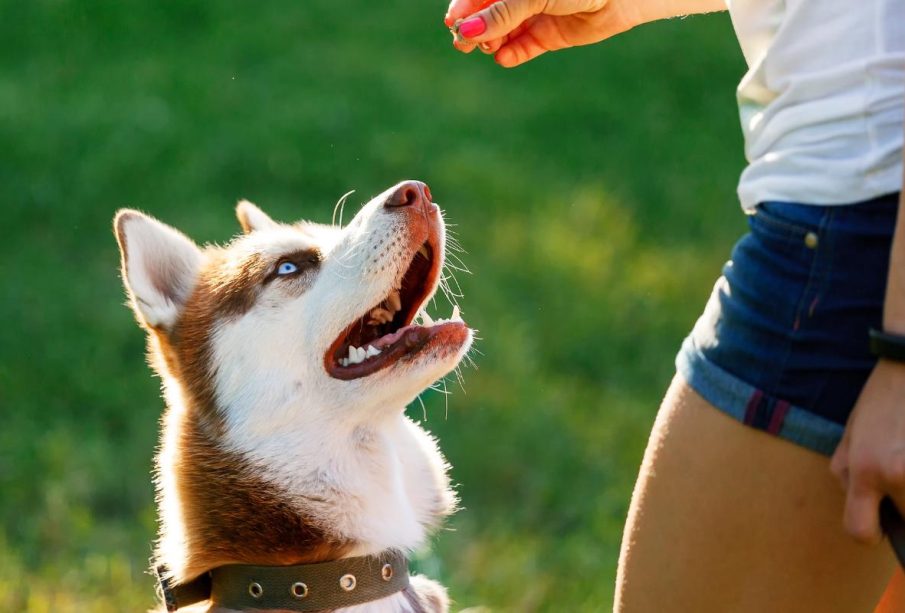
Food is commonly used in reward-based training because it can be delivered quickly and divided into small portions. However, not every dog values every food equally, and the reward that works in the kitchen may become far less interesting at the park.
Many owners keep a small selection of Dog Treats available so they can choose a reward that suits the situation. An ordinary piece of the dog’s daily food may be enough for an easy exercise at home, while something more appealing could be reserved for recall practice or training around distractions.
The objective is not to offer the largest possible reward. It is to find something the dog values enough to repeat the behaviour.
Rewards do not always have to be edible. Depending on the dog, useful alternatives may include:
- A short game with a favourite toy
- Permission to sniff an interesting area
- Access to the backyard
- A chance to greet a familiar person
- Calm praise or physical affection
- The opportunity to continue walking
These everyday rewards can make training feel less like a formal lesson and more like a natural part of the dog’s routine.
Good timing matters more than long sessions
Dogs learn through immediate consequences. If a reward arrives several seconds after the desired behaviour, the dog may associate it with whatever happened in between.
Imagine asking a dog to sit. The dog sits, stands up, takes two steps and then receives a treat. From the dog’s perspective, it may be unclear whether sitting, standing or approaching the owner earned the reward.
A short marker word such as “yes” can help identify the correct moment. Some owners prefer a clicker, which serves the same basic purpose when introduced properly. The marker should occur as the desired behaviour happens, followed by the reward.
This precision is more valuable than extending a session until the dog becomes tired or distracted. Three focused minutes can be considerably more productive than 20 minutes of repeated commands.
Short sessions can be added to moments that already occur throughout the day. A dog can practise waiting while a lead is attached, settling while the kettle boils, or making eye contact before the back door opens. These small lessons are easier to maintain and help the dog understand that good behaviour is useful outside formal training time.
Increase difficulty one step at a time
A dog that responds perfectly in the lounge room may appear to forget everything in the garden. This is not unusual. Dogs do not always generalise a behaviour as readily as people expect.
A familiar instruction can feel entirely different when the location, distance or level of distraction changes. Training should therefore progress gradually across three broad areas:
Distance
Can the dog respond when the owner is one metre away? What about three metres or five?
Duration
Can the dog hold the behaviour for two seconds before being rewarded? Can that time slowly increase?
Distraction
Can the dog respond when a toy is on the floor, someone walks past, or another dog is visible at a comfortable distance?
Increase only one of these challenges at a time. Asking for greater distance, longer duration and stronger distraction simultaneously can turn an easy exercise into an impossible one.
If the dog begins making frequent mistakes, reduce the difficulty. Creating an easier success is usually more productive than repeating the cue more loudly.
Use management while learning takes place
Training works best when dogs are not continually practising the behaviour owners want to change.
For example, teaching calm greetings becomes much harder if a dog is allowed to rush towards every visitor. A lead, baby gate or separate room can prevent the usual pattern while the dog learns an alternative.
Management is not an admission that training has failed. It is a practical way to keep everyone safe and stop unwanted habits from becoming stronger.
A dog learning recall should not be given unrestricted freedom beside a road simply to test whether the training works. A long line can provide room to practise without relying on a skill that is not yet dependable.
The same principle applies inside the home. Closed doors can prevent access to rubbish bins, food can be moved away from bench edges, and shoes can be stored while suitable chewing habits are established.
Learn to recognise when your dog needs a break
Reward-based training is not simply a matter of giving food after a command. It also involves creating an environment in which the dog feels safe enough to learn.
Dogs communicate discomfort in subtle ways. Turning the head away, repeatedly licking the lips, yawning, suddenly sniffing the ground or refusing a normally valued reward may indicate stress, fatigue or confusion.
A dog that cannot concentrate near another dog may need more distance, not a better treat. One that loses interest after several repetitions may need a break rather than further encouragement.
Training should finish while the dog is still engaged. Ending on an easy success helps preserve enthusiasm and gives the animal time to rest and process what it has learned.
Make rewards less predictable—not less meaningful
During the early stages of training, rewarding every successful response helps the dog understand the connection between behaviour and outcome. Once the skill becomes reliable, rewards can become more varied.
That does not mean food should disappear overnight. A behaviour that stops producing worthwhile results may gradually weaken.
Instead, owners can begin mixing different rewards. The dog may receive food on one occasion, praise on another and permission to sniff on the next. Particularly difficult or important responses can still earn a higher-value reward.
This variety makes behaviour more resilient because the dog learns that responding is consistently worthwhile, even when the exact reward changes.
Expect progress to be uneven
Learning rarely moves forward in a perfectly straight line. Adolescence, illness, a house move, hot weather or an unsettling experience can temporarily affect behaviour that previously appeared reliable.
When progress slows, consider what has changed. The location may be more distracting, the dog may be tired, or the reward may no longer be valuable in that situation.
Sudden behavioural changes can also be connected to pain or illness. A dog that stops sitting, becomes reluctant to climb stairs or reacts when touched may need a veterinary examination rather than more intensive training.
Keeping simple notes can help identify patterns. Record where the session occurred, what distractions were present and which rewards were effective. There is no need for an elaborate training diary; a few observations can reveal why a particular exercise succeeds on some days and struggles on others.
Build habits that can last
The most effective training routine is not necessarily the most ambitious. It is the one a household can continue after the initial enthusiasm has faded.
Clear expectations, timely feedback and regular opportunities to succeed help dogs understand what is expected of them. Over time, owners also become better at noticing and rewarding good choices before unwanted behaviour develops.
The aim is not a dog that performs perfectly in every situation. Real dogs become distracted, have difficult days and sometimes need additional support. A successful routine creates something more valuable: clearer communication, safer habits and a relationship strengthened through thousands of small, positive interactions.